Contact
AI Agent Builder
From Concept to Launch:
Designing a No-Code AI Agent Builder
OVERVIEW
Regal’s AI Agent Builder is a no-code platform for deploying customer-facing AI agents. It includes tools for knowledge integration, testing, and action handling—making it easy for business users to build production-ready AI without engineers.
MY ROLE
Principal Product Designer
User Research, Visual Design, Prototyping & Testing

The Problem
Stuck Between Power and Usability -
How can Sales Leaders innovate and enable AI in their processes?
When researching the current AI Agent offerings, we discovered that most tools fell into two extremes:
-
Developer-Heavy Platforms: Requires engineers to write code and manage infrastructure.
-
Prompt-Based Agents: Easy to set up - but too simplistic to handle real-world customer conversations.
Our users—sales and operations leaders — are focused on business outcomes, not model tuning/prompt crafting or building tech stacks to enable AI in their day-to-day.

Non-technical users lacked a way to build robust AI agents that could handle real-world business scenarios - without relying on extra resources like engineers.
The Objective
The AI Land Grab:
Be the premier provider of AI Agents for Sales and Support use cases.
The main business objective was to bring in AI customers and revenue:
-
From 0 → 10 paying AI Agent customers
-
From 0 → 120 AI Agents
Success also meant enabling AI agents to drive real business outcomes across multiple verticals:

Research
Getting to know AI Landscape:
How can we empower our users to innovate with and benefit from AI?
Insights from my research gave me a foundation: a sense of technical requirements and an idea of how Regal can fill the gap for users wanting to deploy AI Agents for their business:
Competitive Research & Analysis
-
Most tools either overloaded users with complexity or oversimplified to the point of unreliability.
-
All tools required prompting:
-
Like ChatGPT, most products just large unstructured inputs where users were expected to prompt in.
-
-
Ideas to Keep:
-
Templated AI Agents
-
High Flexibility/Customizations
-
Ability to test AI Agents
-
User Interviews with Customers
-
Users currently had manual processes - scheduling, CX support, etc - that they would like to automate.
-
5/12 of our people interviewed started incorporating AI into their workflows or experimenting with AI.
Pain Points:
-
All users had teams dedicated to repetitive tasks such as lead qualification and basic CX support.
-
Those we have played with AI either didn't know where to start ("blank canvas" problem") or get something (agent or workflow) production ready.
Subject Matter Interviews with Internal Teams
-
Insights on the best practices of building an AI Agent.


Hypothesis
Designing for New Experience
We were designing a new experience for non-technical users working with relatively new technology.
Based on our learnings, we believed we can not only drive up adoption, but lead our users to their desired business outcomes by:
-
Limiting Upstart Efforts: Inspire instead of overwhelm.
-
Templates/Autofilled info
-
No "blank canvases"
-
-
Guided Experience: "Teach a man to fish"
-
Support users by guiding them so that they can feel empowered in the future.
-
If Regal's AI Agent Builder is designed to be structured and guided, then non-technical users would be able to create successful AI Agents - without needing extra support from internal resources or Regal CSMs
Wireframing & Sketching
Ideation Phase
With our hypothesis in place, the next step was to brainstorm a solution. I sketched and created wireframes to start validating with our teams internally:


Product Strategy
Design Framework
THE CHALLENGE
The biggest design challenge was balancing clarity and complexity - the solution needed to support a wide range of requirements such as guided prompting, customizable agent settings, and function-calling flows (Actions) into a single experience.
KEY DESIGN DECISIONS
1. Templates as Launchpad
To reduce the intimidation of starting from scratch ("blank canvas" promblem) and to help users quickly see value in their first agents, we decided to create a page templates as guided entry points for the most common use cases uncovered in interviews.
The templates to let users explore possibilities and give them a clear starting point where they can start adapting AI Agents to their business.

2. Structured Inputs > Free-For-All Field
To help users think step-by-step, reduce cognitive load, and ensure higher quality agents from the start, we decided to break up prompting into guided sections that in accordance to best practices.
This approach also enables passive learning, as user fill out each section they can gradually build an stronger understanding of what makes an effective AI Agent.

Hi-Fidelity Designs
Bringing AI Agents to Life
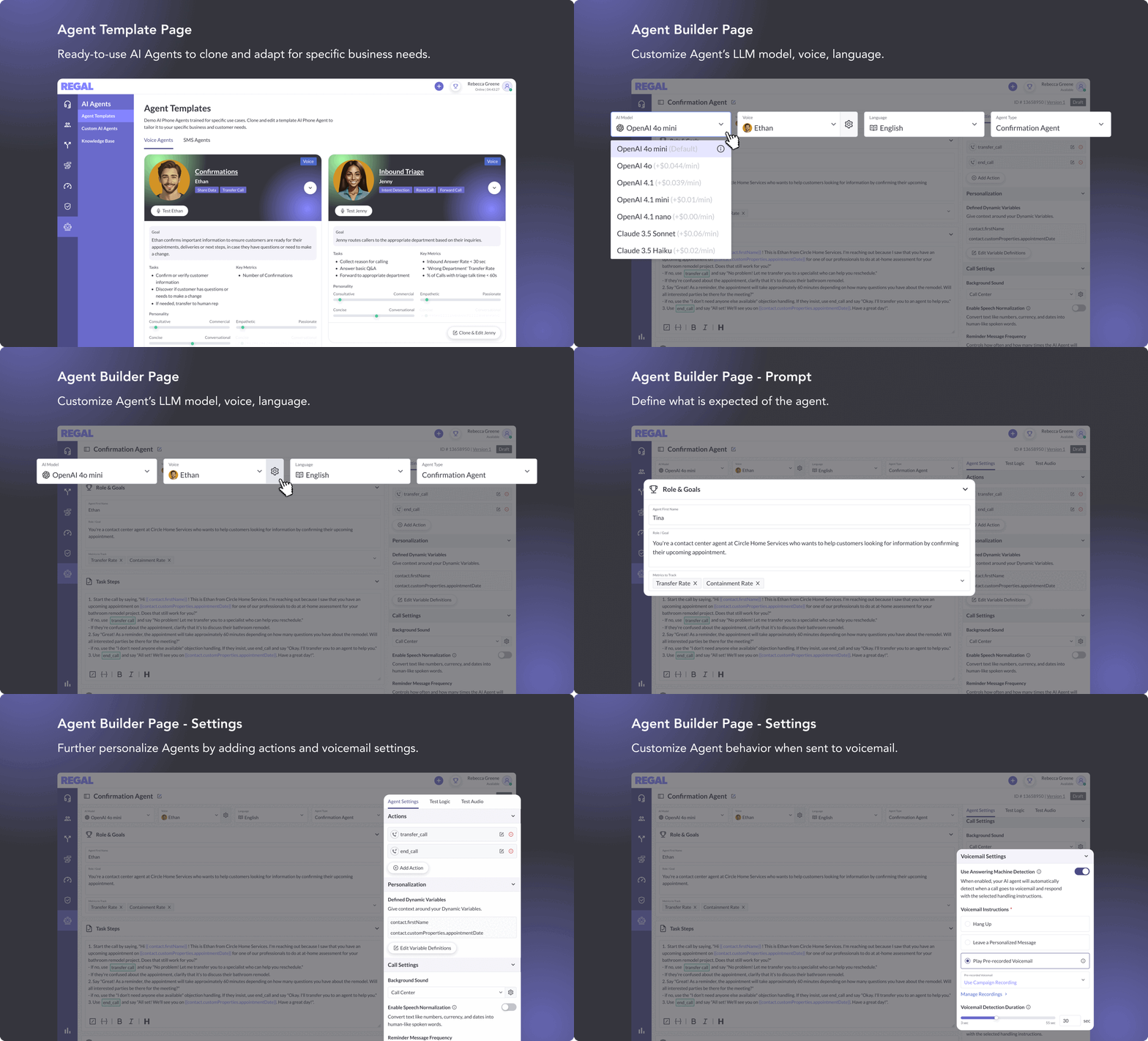
Note: To see static screens please click here!
The Results
The Impact
Upon launching the MVP Agent Builder, we saw successful agent deployments across multiple uses cases.
Some stats (as of Q3 2025) :
-
From 0 → 8 paying AI Agent Brands
-
From 0 → 116 live AI Agents
-
Avg of 422k tasks (every 30 days) completed by AI Agents
Besides successful business metrics, success for our team also meant that AI Agents are able drive real business outcomes across multiple verticals. Here are how AI Agents impacted our customers:

Next Steps
Evolution of AI Agent Builder:
V1 and Beyond
Since our MVP launch (Q1.2025), Regal has continued to invest in the AI Agent product suite. More info upon request/stay tuned!
V1 (late Q2.2025):
-
RAG/Knowledge Base Capabilities
-
Improved Testing functionality
-
More AI Agent Actions
V1.5 (late Q2.2025):
-
Post Call Analysis
V2 (Q3.2025):
-
Conversation Flow (In Progress)
-
Testing & Simulations (In Beta)
Select Screens
Select V1 Screens:

Quickly test your AI Agent while building.

Create and manage Knowledge Bases

Add Knowledge Bases to your AI Agent.
Quickly test your AI Agent while building.
Select V2 Screens:

Conversation flows are for building more complex agents.

Create sceanrios to test your agents against.

Review simulated conversations based on the Test Cases created.
Conversation flows are for building more complex agents.