Contact
Regal Platform
Designing the Core Regal Experience 0 ➡ 1:
OVERVIEW
Regal is a dynamic contact center platform (CCaaS) tailored for businesses in high-consideration industries like healthcare, financial services, home services, and education. The Regal platform makes it possible for brands to give their customers a high-touch experience in an effective and efficient manner.
With omni-channel outbound and inbound capabilities, unified customer profiles, and automation tools that ensure timely and relevant interactions between brands and their leads, Regal provides a full suite of contact center tools that improve efficiency and drive better customer outcomes for our users.
MY ROLE
Founding Product Designer
Worked closely with PMs, engineering teams, and co-founders to design, build, QA, and iterate the essential features of the Regal platform. Main responsibilities include:
-
Owning UI/UX design end-to-end
-
User research and testing
-
Collaborating with stakeholders on requirements and product strategy
The Starting Point
One Size Doesn't Fit All: Expanding the Core Experience.
OVERVIEW
The Regal platform in its early stage was primarily focused on outbound use cases. With basic CRM capabilities and various data streams (via integrations and APIs), businesses can manage leads and enable the automation of call and text tasks, which appear on Regal’s dialer (Agent Desktop). Regal also offered common CCaaS managerial features, such as task routing and basic workforce management that were either basic or not exposed to our users.
THE PROBLEM
As Regal started serving more users, there was a clear signal that while the early state of Regal was powerful, it was not robust or flexible enough to accommodate the unique needs and workflows of our users:
-
Sales Agents:
-
The Agent Desktop feature was best suited for agents that worked for businesses with shorter sales cycles and high volume of leads.
-
Built on third-party platform so it had limited functionality
-

-
Sales Leaders:
-
Regal’s core category-defining features like data-driven automation and expected CCaaS features were not exposed for self-service.
-
Product Vision
The Regal Way: High Touch yet Cost Effective Approach to CCaaS
At its inception, Regal’s overall vision was to pioneer a new “high-touch", data-driven, and cost effective approach to CCaaS. To address the growing needs of users and to realize its goal, the platform needed to further evolve by introducing more self-serve capabilities such as a Journey Builder to empower users to create their own data-driven automations, a unified 360 view of customers to provide more context, and an improved agent experience that prioritizes flexibility and efficiency.
To build this complete suite of contact center tools, the product vision can be organized into these key areas or table stakes:
-
Effective tooling for Agents
-
Flexible workstation for Agents
-
Omni-channel capabilities
-
-
Effective Tooling for Managers
-
Automation & orchestration
-
Self-Serve workforce management
-
-
Ingestion of Customer Data
-
Source of truth for Regal Users
-
Powers data-lead decisions
-
These table stakes laid the groundwork for Regal to reimagine the sales cycle - empowering brands to engage customers with precision, consistency, and a human touch at every stage.
Research
Know Thy User
To inform overall product decisions and to foster deeper understanding internally, I conducted shadowing and interview sessions to develop personas that represented the users of the Regal Platform. The information gathered in this exercise shaped how we approached each body of work represented in the product vision.
Agent Personas:


Manager Persona:

Along with these personas that gave high level insights/direction, specific research was also done for each body of work to answer questions and hone into how to best design a feature to meet users’ needs. Competitive analysis, internal and user interviews were some of the common methods used.
Design
Designing for New Experience
OVERVIEW
Over the span of a few years, the Regal team has iteratively worked towards bringing the product vision to life. This case study will highlight a few of Regal's table stake features:
-
Agent Desktop
-
Improved workflows for agents
-
-
Journey Builder
-
Automation tool that bridges marketing & sales
-
-
Custom Objects
-
Extend data models that powers automation and enhances agent workflows.
-
Each table stake was designed and built to empower our users to reach their revenue goals effectively and efficiently.
DESIGN PROCESS
My design process is based on Lean UX and incorporates discovery, definition, ideation, and implementation phases.
During the ideation phase, my approach is to envision and design the best possible solution, unconstrained by resources. By designing a vision state, PMs and I can easily reverse engineer an MVP and determine the phasing of a project. This approach also allows us to ship more frequently and iteratively to quickly validate our decisions and the flexibility to pivot based on learnings.

Agent Desktop
Improving the Workflow for Agents
BACKGROUND
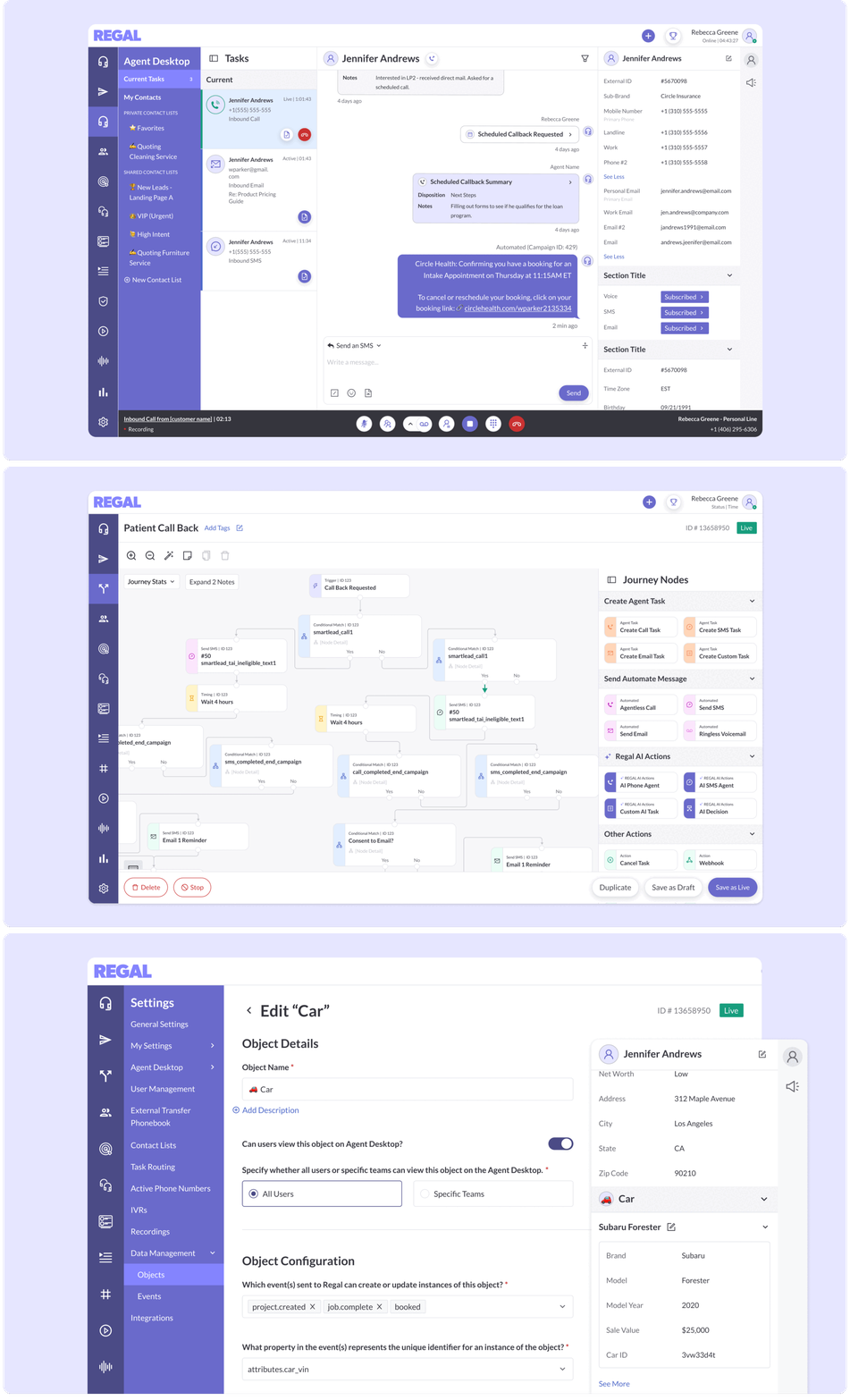
Agent Desktop is the interface where agents interact with leads and manage tasks created through Journey Builder. It provides a 360-degree view of the customer, consolidating every interaction across phone, SMS, and email to equip agents with all necessary context. This unified view enables agents to personalize communications and efficiently execute tasks during each customer engagement.
DISCOVERY
As a team, Regal has shadowed and interviewed agents using the Regal Agent Desktop throughout the years to get feedback and continually improve the product.

OBJECTIVES
Based on our learnings we’ve made several updates to the Agent Desktop to better serve agents. These are selected highlights covered in this case study:
-
Agent Desktop Facelift: We stripped out the underlying third-party functionality and UI to create a cohesive, branded experience that optimizes for efficient agent workflows.
-
Contact Lists: We introduced features that cater to agents with longer sales cycles who need more control over their leads.
-
Email Channel: To streamline communication, we integrated an email channel, reducing the need for agents to switch between Regal and a separate email client.


Journeys
Automating Orchestration for Managers
BACKGROUND
The Journey Builder tool that automates customer interactions by orchestrating personalized, cross-channel communication journeys. It uses triggers based on customer actions or data to send targeted messages via phone, SMS, or email, guiding customers through tailored experiences that drive engagement and conversion. For example, A healthcare provider can use Journey Builder to automatically send appointment reminders and follow-up care instructions via SMS and phone calls based on patient actions, ensuring a proactive and seamless patient experience.
Journey ensures timely, relevant outreach, enhancing the customer journey from initial contact to long-term retention.
DISCOVERY
As a team, Regal interviewed managers to get insight on their goals and their experiences using other similar features.

OBJECTIVES
Based on initial discovery, we learned that it was imperative for our users to be able to create and edit their own journeys. The team started by building the first iteration of Journey Builder to empower our users to at least create simple journeys and based on more feedback, the team has added more features. These are few highlights covered in this case study:
-
Surface Journey Builder: Our journeys were created by our CS teams for our users and were not exposed to our users. This was not only unscalable for our internal teams, it also encumbered our users.
-
Journey Improvements: Improvements like collaborative features and robust capabilities were needed as more users interacted with the journey product.


Custom Objects
Complete Customer View via Data Integrations
BACKGROUND
Custom objects are flexible data structures that allow businesses to store and manage unique information specific to their needs, beyond standard data types like contacts or accounts. Event data used to define custom objects and to show the relationship between objects and contacts. Custom Objects are surfaced on the Agent Desktop, giving agents a more complete view of the customer by including specific data relevant to their interactions.
Custom Objects help agents make more informed decisions and provide a better customer experience and give managers deeper insights into customer data, allowing them to optimize workflows, track key metrics, and make more strategic decisions to improve team efficiency and customer outcomes.
DISCOVERY
I conducted shadowing sessions to observe how various customers organized and used data within their CRMs, ensuring our solution would seamlessly integrate and meet their specific needs.

OBJECTIVES
Many of our users’ tech stack involves a CRM tool, such as Salesforce or Hubspot, which is integrated with Regal allowing the flow of data to and fro. Initially Regal Users would have to user Regal concurrently with their CRM tool. By building a full suite of product for Custom Objects, our customers now can benefit from an even more seamless data integration between their CRM and Regal:
-
Custom Objects Experience in Agent Desktop: Surfacing the data integrations to Agents so that they have a complete view of the customers they are working with.
-
Custom Objects Admin: Configuring how data from a CRM will flow into Regal and be surfaced to agents.


Conclusion
Designing for New Experience
OVERVIEW
Over the course of several years, Regal evolved from a powerful but narrowly focused outbound dialer into a robust, flexible, and self-serve contact center platform. Through close collaboration with PMs, engineers, and stakeholders, and by grounding every decision in research and iterative design, I helped shape Regal’s core experiences — from agent workflows to customer journey automation and data extensibility.
By introducing foundational features like an improved Agent Desktop, a self-serve Journey Builder, and Custom Objects, we enabled our users to work more efficiently, personalize interactions at scale, and manage their data in ways that matched their unique workflows. These initiatives not only enhanced the usability and flexibility of the platform but also aligned Regal’s product capabilities with its long-term vision of providing high-touch, data-driven customer experiences.
IMPACT
The results speak for themselves. By rolling out the redesigned Agent Desktop, self-serve Journey Builder, and Custom Objects, Regal has helped its customers achieve striking gains in efficiency, conversion, and ROI:
-
10 million+ ROI-positive conversations per month
-
547% ROI over three years for a composite organization — translating to $19.1M in benefits vs. $3.5M in costs.